9/11 in London,
25 Years On
An American family abroad, a city in mourning, and an unexpected sense of home.
An American family abroad, a city in mourning, and an unexpected sense of home.
We moved to London in summer of 2001 for my sabbatical year. I was an anthropology professor at Washington University in St. Louis; my wife oversaw the university’s study abroad programs. My adolescent daughter Abby and son Jordan and I settled into a flat near Hampstead Heath; my wife joined us a few months later.
As best we could we wanted to be Londoners that year. Students abroad sometimes try to create a bubble of their own culture. When I studied in Florence as an undergraduate, some of my fellow students spent a surprising amount of time missing the comforts of home, grousing about differences, and looking for a bar where they could get a Bud.
I know what’s behind them doing this. It’s not just that they love Budweiser; it's the uncomfortable sense of being unmoored, especially when something goes wrong, as it often does in a foreign place. But what a waste; why live in Florence and not really be in Florence?
We wanted to really be in London.
We knew few other Americans in London and rarely saw them. Abby and Jordan enrolled in a British school in Camden, not the American School in St. John’s Wood. Their friends were British, and they picked up Britishisms, rode the tube, watched Arsenal football and Big Brother (“Big Bruva”). We ate a lot of curry. I set a policy of no beef – as a food & agriculture researcher I was put off by the small amount of variant Creutzfeldt-Jakob disease in British beef – and anyway I thought we could do without hamburgers for a year.
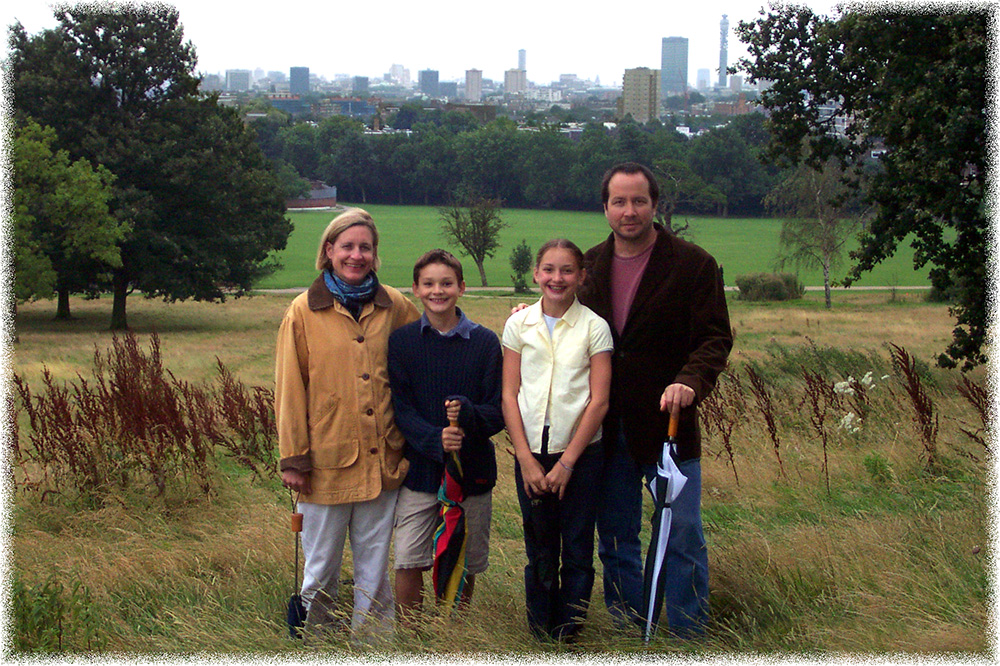
I not only loved London – hard not to – but began to feel at home there. One time returning from an academic conference, when the immigration officer at Heathrow asked how long I would be visiting, I said “Actually I live here.” When he replied “Then welcome home sir” I felt a strange thrill.
9/11 was a Tuesday. After dropping the kids off at school and spending an hour reading London newspapers in a coffee shop in Dartmouth Park, I returned to our flat to write. That afternoon I watched the horrors unfold on TV before picking up the kids at school. They were stunned.
Over the next two days, as we tried to get our heads around what had happened, I realized that now I was the one who felt unmoored in a foreign land. I suddenly felt uncomfortable in London. I didn't want to be there any more. I wanted to be with Americans. I wanted to be in the States. I wished I were back in New York where we used to live.
Americans were stranded because their flights home were canceled and I tried to call the consular section of the US embassy to offer emergency housing for a few people. I wanted to help, but I also just wanted their company. But the phone lines were jammed.
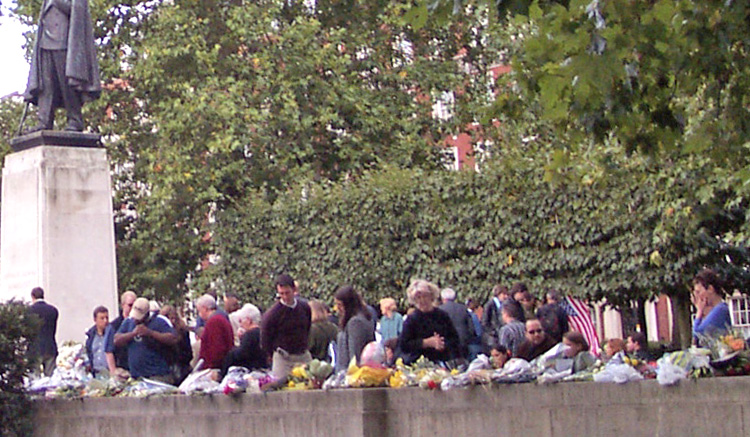
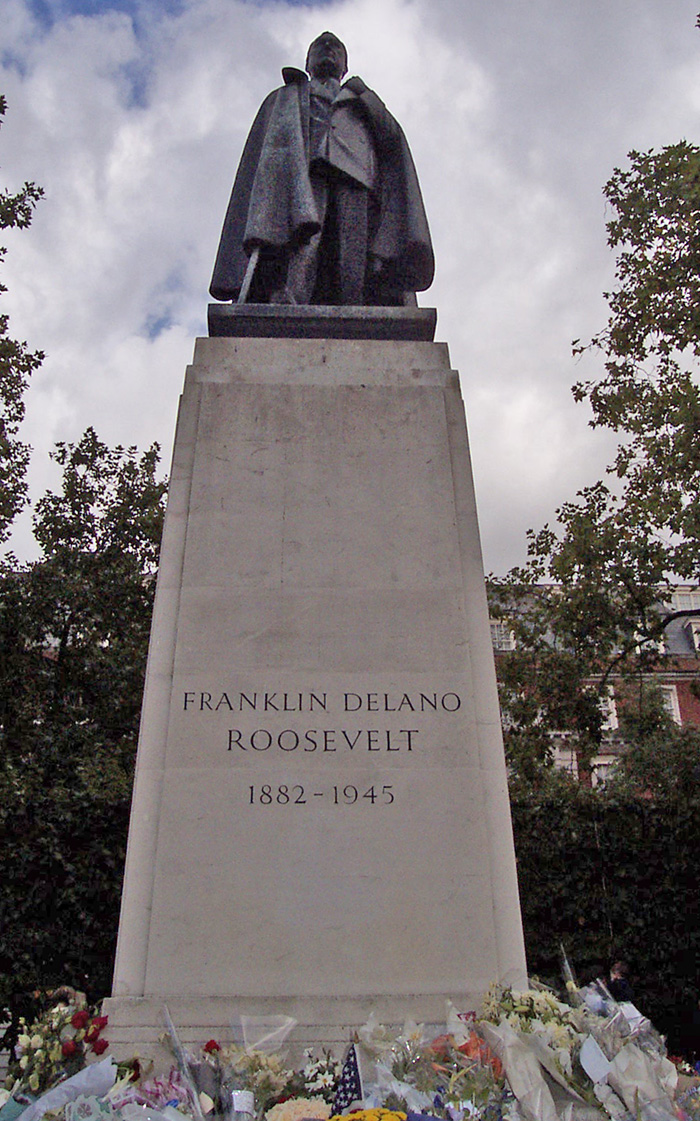
On the 15th the kids and I headed down to Mayfair for a public gathering in Grosvenor Square. This was the most American spot in London, across from the American Embassy, and with a large statue of FDR. We ducked into a restaurant on the way for lunch and we agreed to break our no-beef rule to have the most American thing on the menu – hamburgers (with “chips”). It felt like the right thing to do, although frankly the burgers were not very good.
The square had been chained shut after the attacks but now, with tight security, was open to mourners who were coming in droves. The queue snaked around the park. But if I wanted to commune with Americans this was the wrong place; these were Brits.
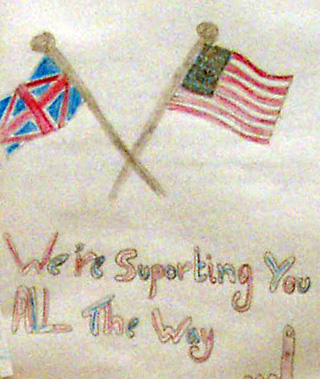
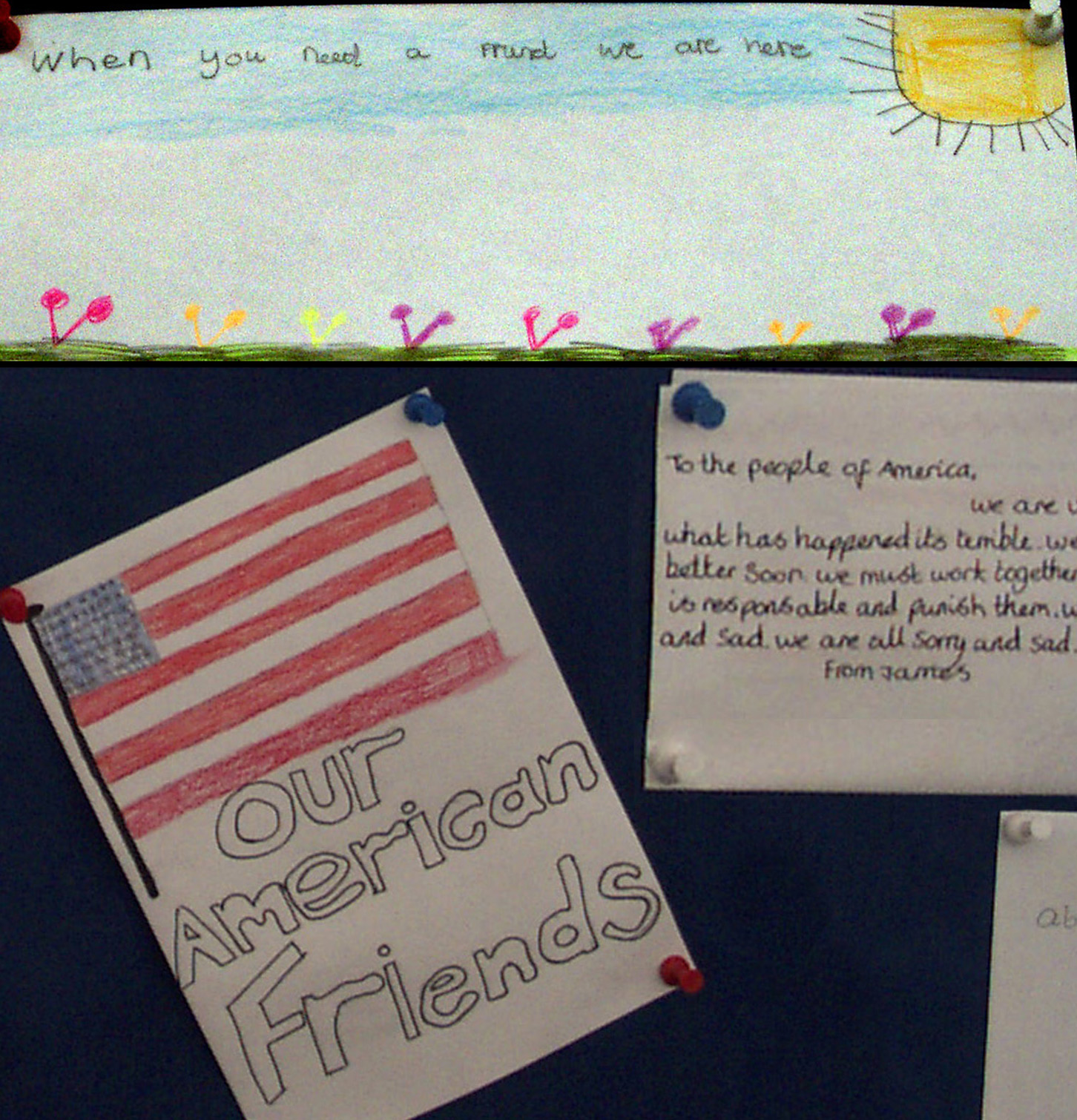
In the square we came to a Condolences Tent, where people were writing messages into large ledger books, not knowing who would ever read them, many weeping as they wrote. The tent had a bulletin board with drawings from British schoolchildren, reaching out to the children of New York.
 |
 |
Out in the square were the flowers. Hundreds, probably thousands, of bouquets, engulfing FDR, spilling out across the pavement and along the walls. Heartfelt messages were attached: “11-9-2001 WHY???”, “Be Strong,” “Rest in Peace,” “Breaking Our Hearts,” “If Only We Could Fight Terrorism With Flowers,” “You are not alone”. They were addressed “To Our American Brothers,” “To Our Friends Across the Sea,” “To All New York.”
The wishes were from all over England -- from Kent, Essex, Ipswich, York, Hertfordshire, Derby and Dorset. But most were specifically from London -- “To All the New Yorkers, From All Your Cockney Friends”; “To the Greatest City in the World...From the Second”; “HOW we Londoners grieve for you New Yorkers.”
Some were to particular victims: “To Julie, Rest Peacefully Now,” “To our brothers, from the London Fire Brigade”. One card read “To the Little Girl Whose Doll was Found in the Debris” -- attached to a small, old, and well-worn bear that looked like it had sustained several childhoods, now left anonymously to a foreign child who would never see it.
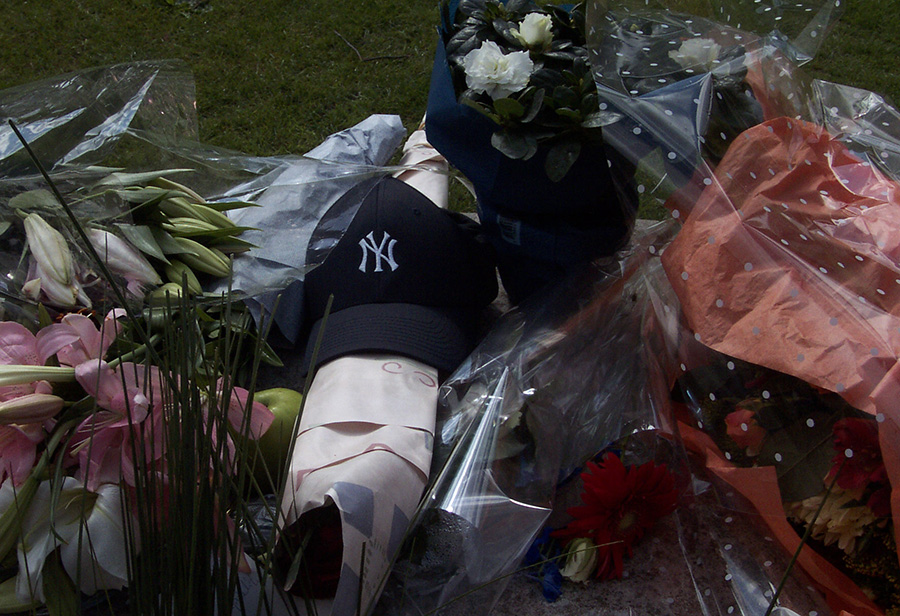
Some left tokens of Britain -- a Paddington Bear, an Arsenal scarf, a tiny London flag and pole, at half mast. Others left momentos of America or New York -- dollar bills, Mets and Yankees caps, an MTA Metrocard. There were Union Jacks and Star-Spangled Banners tied together; a photo of FDR and Churchill.
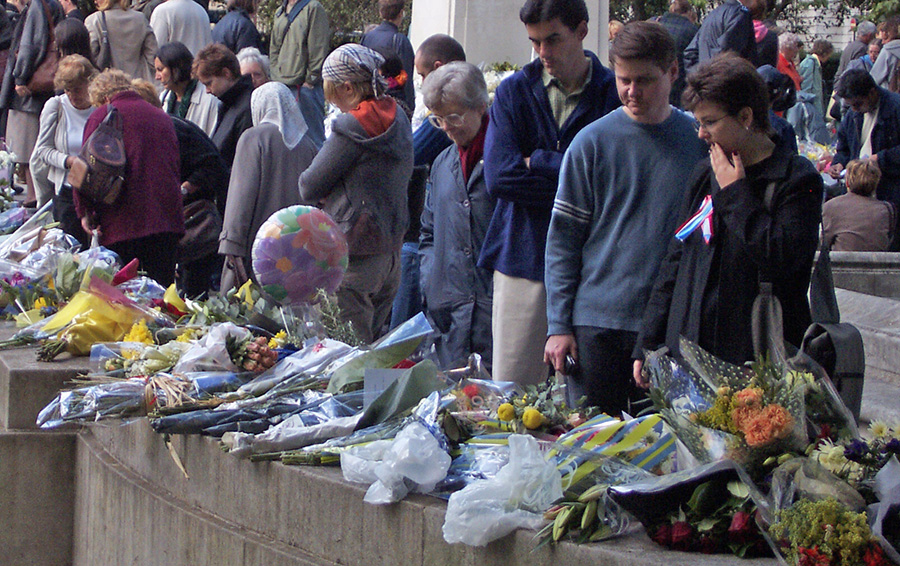
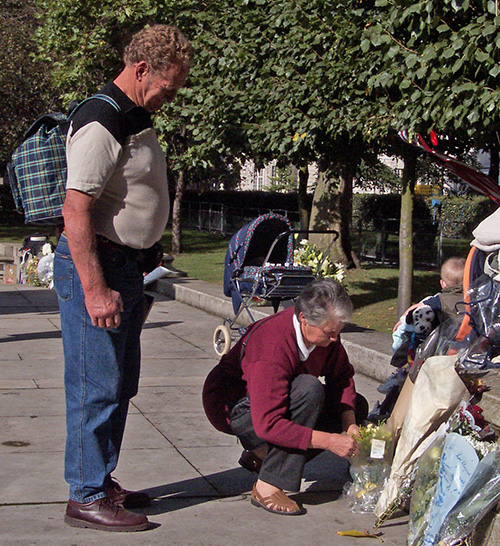
The square filled up with mourners carrying flowers. They just kept coming -- a businessman in a pinstriped suit with a small painting, a young man with spiked hair, a lady on a cane (old enough to have been a mother during the blitz), a tall girl with bright red-white-blue socks and tears trickling down behind large sunglasses, a young mother pushing a pram with a very small baby and a large bouquet of lilies, an elderly man standing stiffly with fists clenched and blinking back tears as his wife gently unwrapped a flowerpot.
 |
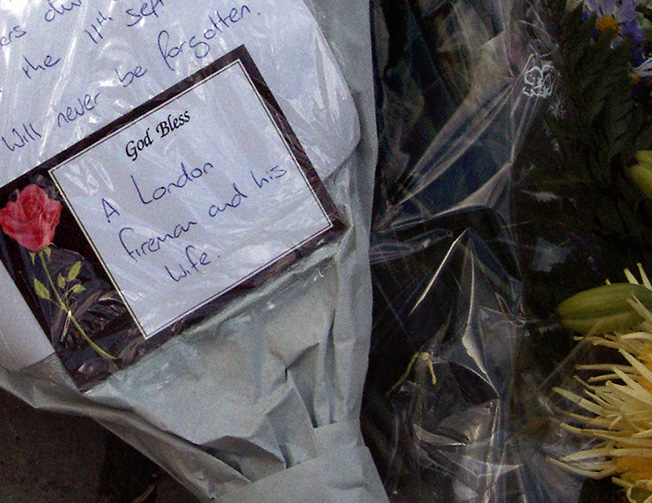 |
At noon the US Ambassador and his wife led the three minutes of silence that was observed all over Europe. Nothing was said before or after, but at the end of the silence a small group from the embassy sang a fragile rendition of the national anthem.
The crowd did not know the words and listened quietly, but at its conclusion began to clap... and then the ovation was taken up through the park and well beyond -- only then did I notice the large crowd behind the border hedges, all the way around the park. For the rest of the week, over 5000 would come daily.
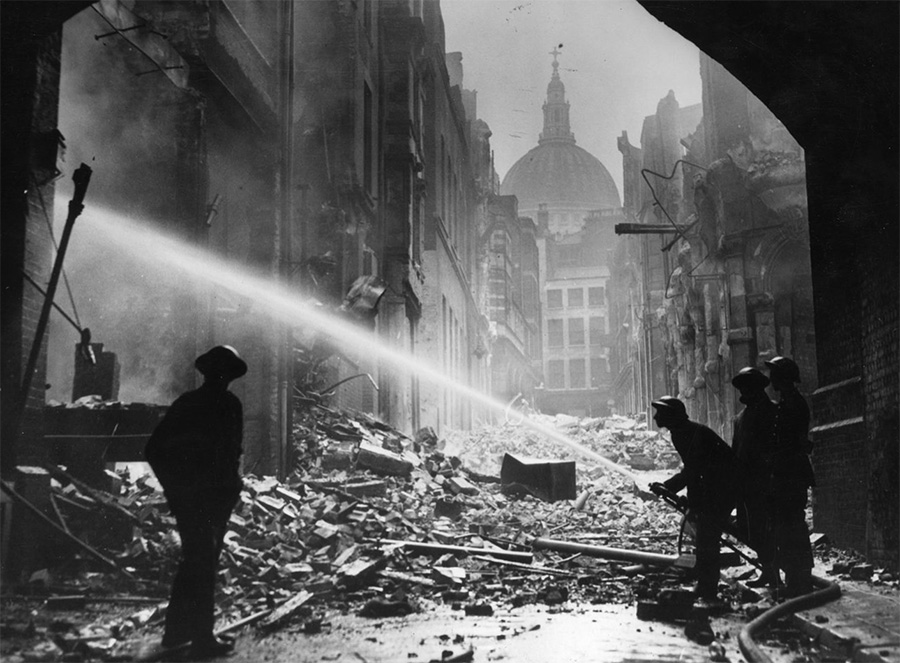
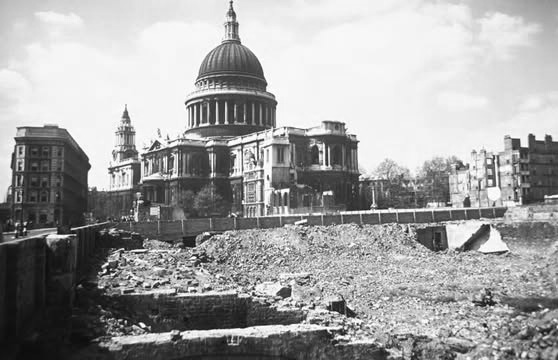
The wave of empathy came not just from simple compassion, but from a bond that runs deep. The huge statue of FDR was financed by private donations from British citizens after the war -- contributions limited to 5 shillings each, and the amount was raised in a day. It was colored by collective memory. No one knows like Londoners what it is like to have your city turned into rubble. Britain lost 40,000 people to the Blitz, half in London; two million homes were hit; one of every six Londoners was homeless at one time before the war ended. Delayed-fuse bombs blew up the firemen and people looking for their families. The Tower of London, Buckingham Palace, St Katherine's Dock, the Houses of Parliament, Westminster Abbey, the British Museum, and much of Oxford Street were all bombed. St Paul's Cathedral took a bomb but kept standing.
 |
 |
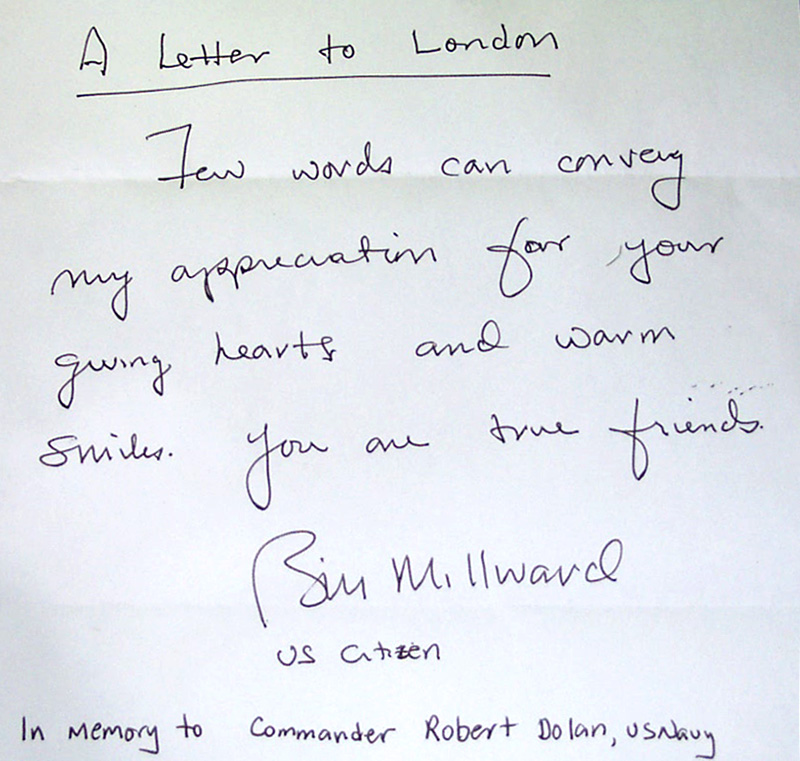
I thought I had come to the most American spot in London, to feel moored again, but I had found something better.
A London embrace, warm and tight and knowing and sincere.
Yes, it was a horrible day for America.
But a very good day to be in London.